L’attacco di Stati Uniti ed Israele all’Iran ha innescato un’escalation bellica che sta incendiando l’area tra il Mediterraneo e il Golfo Persico.
Una deflagrazione a livello globale appare sempre più vicina.
Il rischio per chi si oppone al regime teocratico iraniano in una prospettiva internazionalista, di classe ed antipatriarcale è che il regime, indebolito dopo l’insurrezione di gennaio, si rinforzi di fronte agli attacchi.
A Stati Uniti ed Israele non importa nulla delle aspirazioni di libertà costate non meno di ventimila morti e diecimila prigionieri politici a chi ha scelto di sfidare la Repubblica islamica.
Trump non mira ad un cambio di regime che risponda alle istanze degli insorti e delle insorte perché gli è sufficiente strappare accordi favorevoli in campo energetico.
La posta in gioco per gli Stati Uniti è il controllo delle risorse e dello stretto di Hormuz, l’isolamento della Russia, la fine del commercio di idrocarburi con la Cina.
Israele prova a regolare i conti con Hezbollah, facendo leva sulle divisioni tra gli sciiti libanesi.
È un’operazione azzardata, specie se il governo israeliano non si accontenterá di controllare la striscia sino al fiume Litani, tentando un’operazione di terra più in profondità, che potrebbe essere molto impegnativa sul piano militare e foriera di nuove proteste ed iniziative disfattiste su quello interno. Netanyahu si muove sul filo del rasoio, con una mossa calcolata per arrivare con posizioni più forti alle elezioni. Il governo del Likud e dei suoi alleati dell’estrema destra religiosa punta sull’espansione in Cisgiordania e sulla guerra per evitare una bocciatura alle urne, che decreterebbe la fine politica del premier e dell’attuale alleanza di governo. Tuttavia la carta del compattamento di fronte ad un nemico storico rischia di risultare logora specie se il conflitto non sarà breve: dal Nord del paese, colpito da una pioggia di missili, fuggono nuovamente a migliaia.
Il 30% della popolazione di Israele, quella più povera, non ha rifugi sicuri contro le bombe.
Le guerre commerciali dell’amministrazione Trump non hanno sortito gli effetti sperati, erodendo parte del consenso raccolto promettendo il ritorno all’età dell’oro, con gli States nuovamente perno dell’economia mondiale.
I sondaggi indicano una secca perdita di consensi che potrebbe risultare disastrosa alle elezioni di midterm.
L’amministrazione Trump, dopo il colpo di mano in Venezuela, gioca ancora una volta la carta militare, perché è l’unico ambito in cui mantiene un’indubbia superiorità sui propri competitors più forti.
Un azzardo non privo di rischi, come dimostrano i tragici esiti delle guerre scatenate dagli States in Iraq ed Afganistan. Paesi dove la potenza militare statunitense ha consentito una vittoria sul campo che si è mutata in sconfitta, perché la ferocia dell’occupazione militare, l’assenza di solidi alleati, che solo massicci investimenti a fondo perduto avrebbero potuto garantire, ha portato a ritirate che dimostrano l’incapacità statunitense di attuare i propri progetti coloniali.
L’Iran non è il Venezuela. Lo dimostrano gli attacchi ben più forti ed incisivi rispetto alle pantomime attuate durante la guerra dei 12 giorni dello scorso giugno.
Non solo.
A quindici giorni dall’inizio di questa nuova cruenta fase del conflitto, gli Stati Uniti e Israele, pur avendo inflitto durissimi colpi all’apparato militare iraniano, massacrando oltre mille civili, non appaiono in grado di controllare la situazione. Il tentativo di usare le milizie curde iraniane sinora è stato respinto al mittente dalla neonata coalizione dei partiti dell’area curdofona dell’Iran.
Il caos sistemico cui probabilmente punta Trump potrebbe incrinare le alleanze statunitensi nell’area, che già oggi sono meno solide che in passato.
Basti pensare ad un paese come la Turchia, uno storico alleato che ormai da tempo si muove in proprio, sostenendo attivamente le fazioni palestinesi che fanno riferimento ad Hamas in Palestina, alleandosi con Al Jolani in Siria e regolando i conti con l’opposizione curda. Oggi la Turchia si candida al ruolo di perno dell’area in chiave neottomana, in diretta concorrenza con Israele.
In Iran l’opposizione politica e sociale internazionalista, di classe e anarchica si oppone alla guerra. La guerra di Trump e Netanyahu non è combattuta in loro nome. La morte del tiranno non porta alla fine della dittatura, perché solo la lotta di chi, dal basso, prova a spezzare l’ordine clericale e patriarcale, può aprire reali orizzonti di libertà, innescando un processo rivoluzionario.
Le bombe israeliane e statunitensi massacrano la popolazione civile mentre un regime sempre più sanguinario e feroce priva del cibo i prigionieri politici e li usa come scudi umani nelle basi militari.
Gli anarchici iraniani si oppongono alla guerra e al regime.
Disertor e obiettor* israeliani hanno appoggiato l’insurrezione in Iran e si oppongono alla guerra.
A loro va il nostro sostegno.
Nel nostro paese si sono viste piazze animate da alcuni settori di esuli inneggiare all’attacco di Israele e Stati Uniti all’Iran.
In altre piazze, promosse dalla variegata sinistra italiana, sono sventolate le bandiere della Repubblica islamica e immagini di Khamenei.
Segnali inquietanti.
È un momento buio.
L’Italia, da anni piattaforma logistica per la guerra in Ucraina e a Gaza, oggi ha un ruolo nevralgico nel supporto alla guerra in Iran.
Le basi di Sigonella e il Muos di Niscemi hanno un ruolo centrale nelle operazioni di intelligence bellica.
La fregata missilistica Martinengo è stata dislocata a Cipro, aiuti militari sono stati inviati ai paesi del Golfo.
Il governo nega di voler entrare in guerra, ma il nostro paese è già in guerra da anni.
Missioni militari italiane sono da decenni attive in Iraq, in Kuwait, in Libano, a Cipro, in Palestina, in Egitto, oltre che nel Mar Rosso e nel Corno d’Africa.
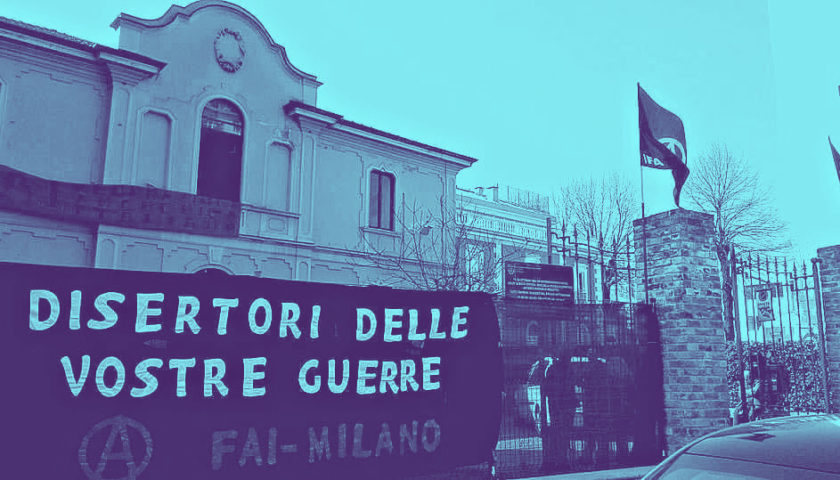
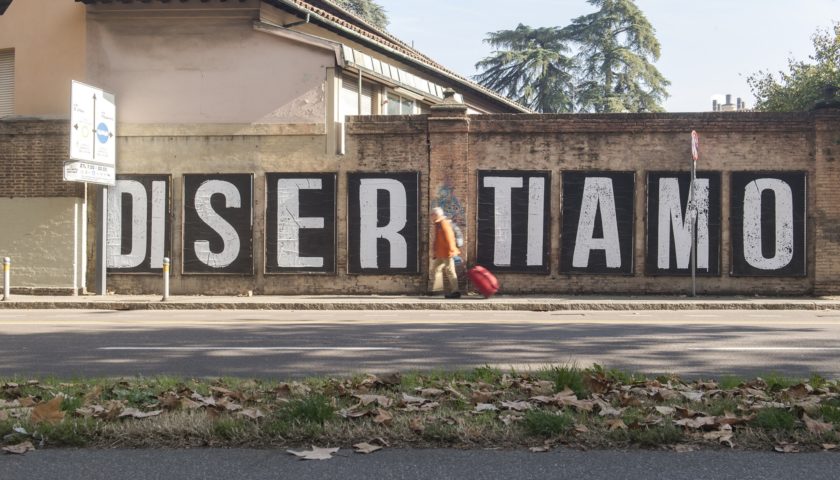
Noi disertiamo.
Noi non ci arruoliamo a fianco di questo o quello stato.
Noi siamo al fianco di chi, in ogni angolo della terra, diserta la guerra.
Vogliamo un mondo senza frontiere, eserciti, oppressione, sfruttamento.
Solo un’umanità internazionale potrà gettare le fondamenta di quel mondo di libere ed uguali che può porre fine alle guerre.
La lotta per la chiusura delle basi militari italiane, statunitensi e Nato è oggi più che mai cruciale.
Disertare la guerra non è un semplice slogan, ma una pratica concreta, che si rinforza nell’alleanza transnazionale di oppress* e sfruttat*.
Sabotiamo la guerra!
La Commissione di Corrispondenza della Federazione Anarchica Italiana
—————————————–
Iran. Let’s desert the war!
The US and Israeli attack on Iran has triggered an escalation of war that is setting on fire the area between the Mediterranean and the Persian Gulf.
A global explosion appears ever closer.
The risk for those who oppose the Iranian theocratic regime from an internationalist, class-based, and anti-patriarchal perspective is that the regime, weakened after the January uprising, will strengthen in the face of attacks.
The United States and Israel care nothing about the aspirations for freedom that cost no fewer than twenty thousand deaths and ten thousand political prisoners to those who chose to challenge the Islamic Republic.
Trump is not aiming for regime change that would meet the demands of the insurgents, because he is satisfied with securing favorable agreements in the energy sector.
At stake for the United States is control of resources and the Strait of Hormuz, the isolation of Russia, and an end to hydrocarbon trade with China.
Israel is attempting to settle scores with Hezbollah by exploiting divisions among Lebanese Shiites.
It is a risky operation, especially if the Israeli government is not content with controlling the Strip up to the Litani River, attempting a more in-depth ground operation, which could be very demanding militarily and a harbinger of new protests and defeatist initiatives internally.
Netanyahu is walking a razor’s edge, with a calculated move to secure a stronger position in the elections. The Likud government and its far-right religious allies are banking on expansion in the West Bank and war to avoid a voter rejection, which would spell the end of the prime minister and the current governing alliance. However, the strategy of unity in the face of a historic enemy risks becoming worn out, especially if the conflict is not short: thousands are fleeing from the north of the country, hit by a hail of missiles.
Thirty percent of Israel’s population, the poorest, has no safe haven against the bombs.
The Trump administration’s trade wars have failed to deliver the desired results, eroding part of the consensus it had gained by promising a return to the golden age, with the United States once again the linchpin of the global economy.
Polls indicate a sharp loss of support that could prove disastrous in the midterm elections.
The Trump administration, after the coup in Venezuela, is once again playing the military card, because it is the only area in which it maintains undeniable superiority over its strongest competitors.
This gamble is not without risks, as demonstrated by the tragic outcomes of the wars unleashed by the United States in Iraq and Afghanistan. These are countries where US military power enabled a victory on the ground that turned into a defeat, because the ferocity of the military occupation and the absence of solid allies, which only massive non-repayable investments could have guaranteed, led to retreats that demonstrate the US’s inability to implement its colonial projects.
Iran is not Venezuela. This is demonstrated by attacks that are far more forceful and incisive than the pantomimes carried out during the 12-day war last June.
Not only that.
Fifteen days into this this new bloody phase of the conflict, the United States and Israel, despite having inflicted severe blows on the Iranian military, massacring over a thousand civilians, appear unable to control the situation. The attempt to use Iranian Kurdish militias has so far been rebuffed by the newly formed coalition of parties from Iran’s Kurdish-speaking region.
The systemic chaos Trump is likely targeting could undermine US alliances in the region, which are already less solid than in the past.
Just consider a country like Turkey, a historic ally that has long been acting independently, actively supporting Palestinian factions linked to Hamas in Palestine, allying with Al Jolani in Syria, and settling accounts with the Kurdish opposition. Today, Turkey is bidding to become the region’s linchpin, a neo-Ottoman force, in direct competition with Israel.
In Iran, the internationalist, class-based, and anarchist political and social opposition opposes the war. Trump and Netanyahu’s war is not being fought in their name. The death of the tyrant does not bring the end of the dictatorship, because only the struggle of those who, from below, attempt to break the clerical and patriarchal order can open real horizons of freedom, sparking a revolutionary process.
Israeli and US bombs slaughter the civilian population while an increasingly bloodthirsty and ferocious regime deprives political prisoners of food and uses them as human shields on military bases.
Iranian anarchists oppose the war and the regime.
Israeli deserters and conscientious objectors supported the uprising in Iran and oppose the war.
We support them.
In our country, squares were animated by some sections of exiles chanting Israel and the United States’ attack on Iran.
In other squares, promoted by the diverse Italian left, flags of the Islamic Republic and images of Khamenei were waved.
Disturbing signs.
It’s a dark moment.
Italy, for years a logistics hub for the war in Ukraine and Gaza, now plays a key role in supporting the war in Iran.
The Sigonella bases and the MUOS in Niscemi play a central role in war intelligence operations.
The missile frigate Martinengo has been deployed to Cyprus, and military aid has been sent to the Gulf countries.
The government denies wanting to go to war, but our country has already been at war for years.
Italian military missions have been active for decades in Iraq, Kuwait, Lebanon, Cyprus, Palestine, Egypt, as well as in the Red Sea and the Horn of Africa.
We desert.
We do not enlist on the side of this or that state.
We stand with those who desert war in every corner of the earth.
We want a world without borders, armies, oppression, or exploitation.
Only an international mankind can lay the foundations for that world of free and equal people that can put an end to war.
The fight to close Italian, US, and NATO military bases is more crucial than ever.
Deserting war is not just a slogan, but a concrete practice, strengthened by the transnational alliance of the oppressed and the exploited.
Let’s sabotage war!
The Correspondence Commission of the Italian Anarchist Federation – FAI
Iran. Désertons la guerre !
L’attaque de l’Iran par les États-Unis et Israël a déclenché un engrenage guerrier qui dévaste la région comprise entre la Méditerranée et le Golf Persique.
Une déflagration de niveau mondial semble toujours plus proche.
Pour qui s’oppose au régime théocratique iranien dans une perspective internationaliste, de classe et antipatriarcale, le risque est grand que le régime, affaibli par l’insurrection de janvier, se durcisse avec les attaques.
Les États-Unis et Israël n’accordent pas la moindre importance à l’aspiration à liberté qui a coûté la vie à pas moins de vingt mille personnes et qui a fait dix mille prisonniers politiques parmi celles et ceux qui ont choisi de défier la République islamique.
Trump ne vise pas un changement de régime qui répondent aux demandes des insurgé.es, parce qu’il veut simplement arracher des accords favorables dans le domaine énergétique.
Ce qui est en jeu pour les États-Unis, c’est le contrôle des ressources et du détroit de Hormuz, l’isolement de la Russie et la fin du commerce d’hydrocarbures avec la Chine.
Israël cherche à régler ses comptes avec le Hezbollah, en se servant des divisions entre chiites libanais.
C’est une opération risquée, surtout si le gouvernement israélien ne se contente pas de contrôler la bande jusqu’au fleuve Litani et tente une opération terrestre plus ample, qui pourrait s’avérer difficile sur le plan militaire, et qui pourraient déclencher de nouvelles oppositions et résistances sur le plan intérieur. Netanyahou avance sur une ligne de crête, avec des coups qui sont calculés pour renforcer sa position électorale. Le gouvernement du Likud et ses alliés de l’extrême-droite religieuse comptent en effet sur l’expansion en Cisjordanie et sur la guerre pour éviter une déconfiture dans les urnes, qui signerait la fin politique du premier ministre et de la coalition qui gouverne.
Cependant, jouer la carte de resserrer les rangs face à un ennemi historique pourrait avoir fait long feu, surtout si le conflit s’étend sur la durée : au Nord du pays, de nouveau, les gens fuient par milliers frappés par des pluies de missiles.
30% de la population israélienne, la part la plus pauvre, n’a pas de refuge pour se protéger des bombes.
Les guerres commerciales de l’administration Trump n’ont pas eu les résultats escomptés, entamant le consensus obtenu en promettant le retour de l’âge d’or, où les États-Unis seraient de nouveau le centre de l’économie mondiale.
Les sondages indiquent une nette perte de consensus, qui pourrait s’avérer désastreuse pour les élections des mid-term.
L’administration Trump, après le coup de force au Vénézuela, joue une fois de plus la carte militaire, parce que c’est le seul domaine où elle possède encore une supériorité indiscutable, y compris sur ses concurrents les plus importants.
Un choix qui n’est pas sans risque, comme l’ont montré les conséquences tragiques des guerres déclenchées par les États-Unis en Irak et en Afghanistan. Dans ces pays, la puissance militaire états-unienne a permis une victoire sur le terrain mais qui s’est transformée en défaite, à cause de la brutalité de l’occupation militaire et de l’absence d’alliés solides, que seuls des investissements massifs à fonds perdus auraient pu garantir. Cela a conduit à des retraits, qui ne font que démontrer l’incapacité des États-Unis à mener à bien leur propres projets coloniaux.
L’Iran n’est pas le Vénézuela. En témoignent les attaques bien plus fortes et bien plus offensives par rapport à la pantomime mise en scène pendant la guerre des 12 jours en juin dernier.
Mais ce n’est pas tout.
15 jours après le début cette nouvelle phase sanglante du conflit, les États-Unis et Israël qui ont infligés des coups extrêmement durs à l’appareil militaire iranien et qui ont massacrés plus de mille personnes, ne semblent pas avoir tenir la situation sous contrôle. La tentative de recourir aux milices kurdes iraniennes a été jusqu’ici rejetée par la récente coalition des partis de la région kurdophone de l’Iran.
Le chaos systémique que cherche probablement Trump pourrait fissurer les alliances états-unienne de la région, qui sont déjà bien plus fragilisées aujourd’hui qu’elles ne l’étaient par le passé.
Il suffit de penser à un pays comme la Turquie, un allié historique qui désormais agit pour son propre compte, en soutenant activement les factions palestiniennes qui répondent au Hamas en Palestine, en s’alliant avec Al Jolani en Syrie, et en réglant les comptes avec l’opposition kurde. Aujourd’hui, la Turquie se positionne comme le pilier de la région, dans une perspective néo-ottomane et en concurrence directe avec Israël.
En Iran, l’opposition politique et sociale internationaliste, de classe et anarchiste s’oppose à la guerre. La guerre de Trump et de Netanyahou n’est pas menée en leur nom. La mort du tyran n’a pas conduit à la fin de la dictature, parce qu’il n’y a que la lutte, par le bas, qui puisse mettre en pièce l’ordre religieux et patriarcal , qui puisse ouvrir de nouveaux horizons de liberté à même de déclencher un processus révolutionnaire.
Les bombes israéliennes et états-uniennes massacrent la population civile pendant qu’un régime toujours plus sanguinaire et cruel prive de nourriture les prisonniers politiques et les utilisent comme boucliers humains dans les bases militaires.
Les anarchistes iraniens s’opposent à la guerre et au régime.
Les déserteur.es et les objecteur.es israélien.nes ont soutenu l’insurrection en Iran et s’opposent à la guerre. Tout notre soutien à elles et eux.
Dans notre pays, on a vu des manifestations organisées par certains groupes d’exilés iraniens soutenir l’attaque d’Israël et des États-Unis contre l’Iran.
D’autres manifestations, organisées par divers groupes de la gauche italienne, ont brandi les drapeaux de la République iranienne et des images de Khamenei.
Ce sont des signaux inquiétants.
Nous sommes dans un moment obscur.
L’Italie, qui depuis des années est une plateforme logistique pour la guerre en Ukraine et à Gaza, joue aujourd’hui un rôle névralgique dans le soutien à la guerre en Iran.
Les bases de Sigonella et le MUOS de Niscemi jouent un rôle central dans les opérations de renseignement militaire.
La frégate lance-missile Martinengo a été délocalisée à Chypre et des aides militaires ont été envoyées aux Pays du Golf.
Le gouvernement nie de vouloir entrer en guerre, mais notre pays est déjà en guerre depuis des années.
Les missions militaires italiennes sont actives depuis des décennies en Irak, au Koweit, au Liban, à Chypre, en Palestine, en Égypte, ainsi que dans la Mer Rouge et dans la Corne de l’Afrique.
Nous, nous désertons.
Nous ne nous enrôlons pas au côté d’un état ou d’un autre.
Nous sommes au côté de toutes celles et ceux qui, dans tous les coins de la terre, désertent la guerre.
Nous voulons un monde sans frontière, sans armée, sans oppression et sans exploitation.
Seule une humanité internationale pourra jeter les fondements de ce monde libre et égal qui peut mettre fin aux guerres
La lutte pour la fermeture des bases militaires italiennes, états-uniennes et de l’OTAN est cruciale, aujourd’hui plus que jamais.
Déserter la guerre n’est pas un simple slogan, c’est une pratique concrète, qui se renforce par les alliances transnationales parmi les oppressé.es et les exploité.es.
Sabotons la guerre !
La commission de correspondance de la Fédération Anarchiste Italienne